A website for me to put in my reseach progress on tidally locked stellar systems. A nasa page on tidal locking
The age of an M dwarf star is difficult to map out since these stars have yet to evolve off the main sequence. Due to their long life spans and lower masses, core hydrogen fusion proceeds at a much slower rate, making usual age determination methods unreliable for M dwarfs. Fortunately, it is generally accepted that stellar rotational period is a good indication of magnetic activity and that the signatures of activity in the atmospheres of M dwarfs are linked to their age. Among partially convective stars, rotation rate can be used as a clock because spin-down due to magnetic braking, where angular momentum is lost from magnetized winds, occurs in a predictable fashion, and a star’s present-day rotation encodes its age (Shields et al. 2016).
Although observed rotation period distributions of very low-mass main-sequence stars have revealed a need for reexamination of the spin-down, standard rotational evolution models (Kotorashvili & Blackman 2025). This work implies that tidal relations may be able to explain these trends. Their predicted spin evolution is sensitive to orbital separation and to companion mass, so observations of tidally influenced M dwarfs can add to our overall understanding of these discrepancies. Tidal locking, a process where tidal forces alter the rotation of one body orbiting another, changing its rotation period, forces rapid rotation, and rapid rotation enhances magnetic activity. It begs the question of whether tidal locking produces standard activity for its rotation rate, or if binarity introduces additional effects. Information about tidally locked stars is vital because it is suggested that tidally locked rotations can counter the effects of spin-down and therefore make things like age dating harder. Also, note the activity in stars around the convective boundary. As we reach the gap, there seems to be a dip in activity where stars in that transitional period have little to no observable activity, and as you reach further away from the gap on both sides, activity begins to increase (Jao et al. 2023). Any information pertaining to magnetic fields, is important in furthering our understanding of why this happens.
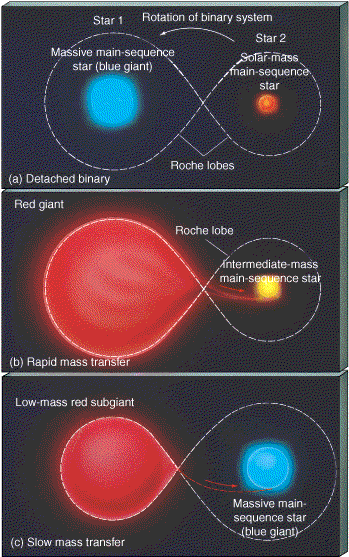
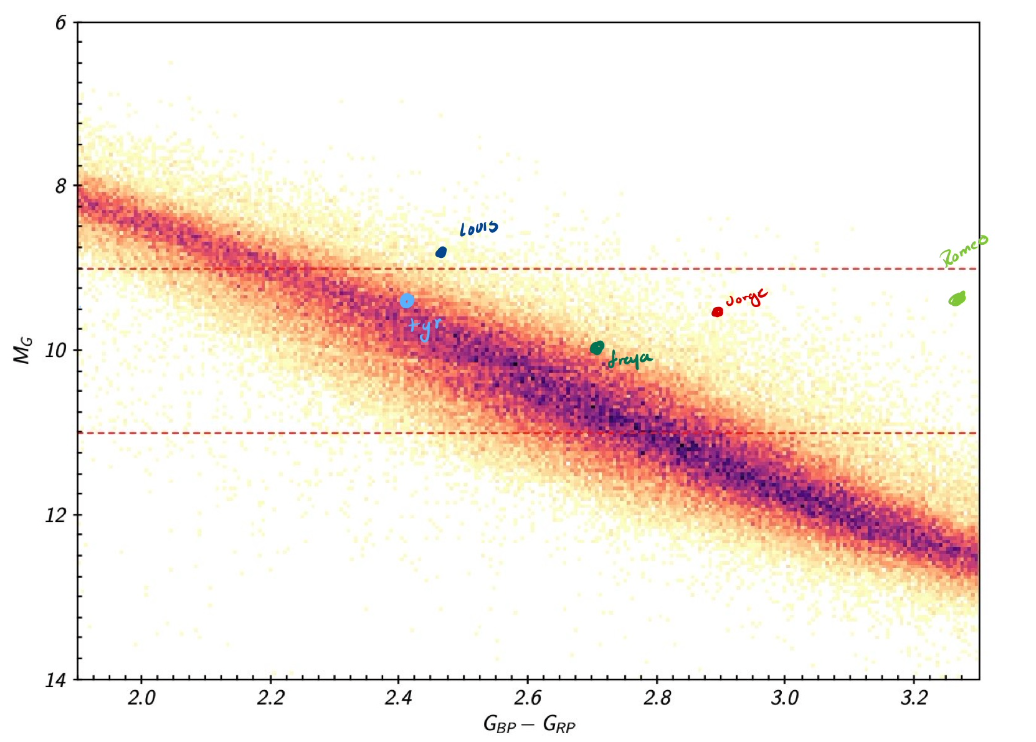
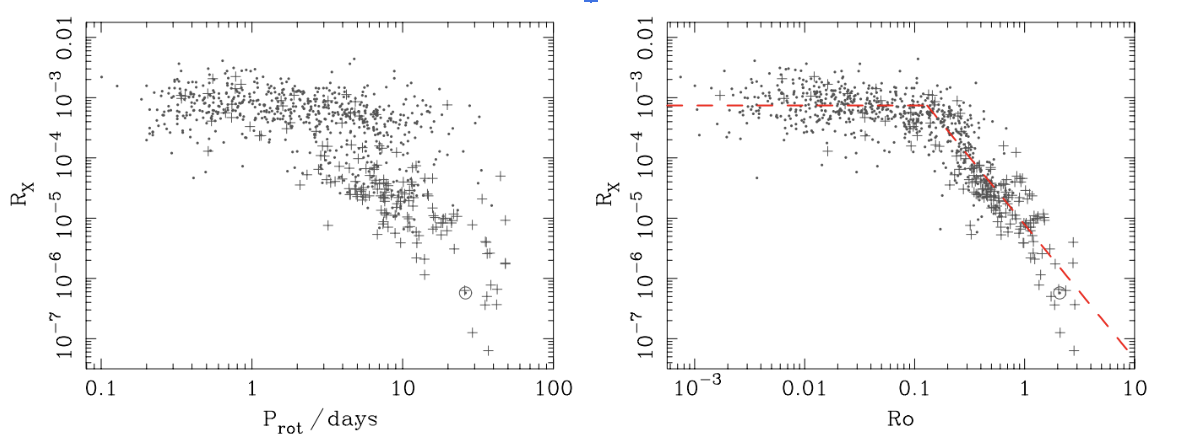
Understanding rotational rate and activity in M dwarf stars is valuable as it adds to many scientific inquiries, like understanding for constraining models of angular momentum loss and how magnetic features impact inferences of exoplanet parameters (Newton et al. 2018) or how modeling’s inability to accurately predict radii of M dwarfs near the convective boundary especially because stars in very short period systems tend to be inflated and magnetically active, likely due to tidally driven rapid rotation. This project’s scientific goal is to compare the light curves of five tidally locked eclipsing binaries (I have not been able to yet confirm their status as tidally locked) – TIC 101220458 “Romeo,” TIC 285181196 “Louis,” TIC 148611095 “Tyr,” TIC 172517058 “Freya,” and TIC 318937509 “Jorge,” observed over six nights at the Perkins Telescope in January 2026. If tidal locking modifies rotation, and rotation is used to infer age and activity evolution, then understanding activity in tidally locked M dwarfs is essential for interpreting rotation–age relations and magnetic evolution models. It is important to look at the activity of each star quantified by flare and starspot occurrence and distribution. Which could aid in understanding how activity varies with orbital phase, if any, where these eclipsing binary stars fall on a rotation vs. activity graph, and how the characteristics of a tidally locked eclipsing binary affect placement. One in particular, TIC 285181196 “Louis,” is a semi-detached eclipsing binary, meaning that the two bodies in this system are in partial contact, and we can potentially explore whether this specific activity behaves similarly to the other stars observed.